The company expanded exports beyond India, Russia, Southeast Asia and the Middle East into the North American market driving overseas sales to exceed 50% of total revenue for the first time this year.

(Photo=Protia)
Diagnostic device specialist, Protia, is aggressively securing the foundation to realize its goal of 100 billion Korean Won (KRW) in revenue by 2030. Following its listing on KOSDAQ in 2023, the company focused intensely on transforming into an export-driven enterprise.
As a result, the number of exporting countries expanded from just 12 at the beginning of the year to 80 countries, and the number of dedicated distributors is expected to grow from 21 to over 90 by year-end.
This aggressive strategic move is reflected in its figures. The export share of total revenue which stood at a mere 5.4% in 2015, is projected to exceed 50% for the first time this year reaching 52.3%. Not stopping there Protia plans to increase the export ratio to 60% next year and over 90% by 2030, as part of its 100 billion KRW revenue plan.
The efficacy of Protia's aggressive strategy is evident in its performance. In the third quarter, Protia achieved 4.034 billion won in sales and 1.175 billion won in operating profit (OP), marking increases of 36.9% and 117.6% year on year (YoY), respectively. This strong showing is expected to drive annual performance to a new historical high.
According to the recent IPO report published by Kiwoom Securities, Protia’s estimated 2025 annual results project 15.5 billion KRW in sales and 4.2 billion KRW in OP. If realized, this would represent growth of 47% and 120% respectively, compared to the previous year.
Even steeper growth is anticipated for the coming year. Global market expansion and increased sales of new products are projected to drive performance. In fact sales of diagnostic equipment (Q-station) a leading indicator for next year's revenue have significantly increased.
Protia sold over 400 units of diagnostic equipment this year alone, a 54% increase compared to the previous year. Since Protia’s diagnostic equipment is specialized for tests using its proprietary reagents increased equipment sales directly translate into reagent revenue growth.
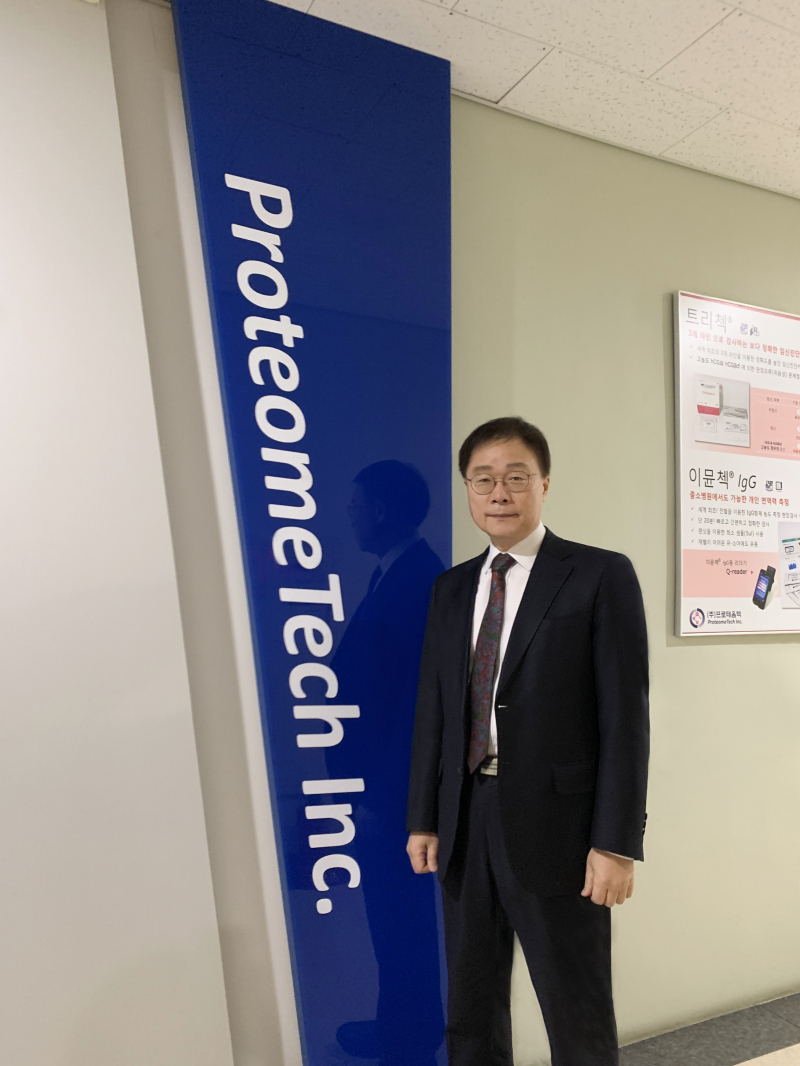
Protia CEO Gukjin Im. (Photo=Protia)
This external growth is underpinned by Protia’s differentiated technological competitiveness and expansion of its product portfolio.
The first pillar is ultra precision allergy diagnosis technology. Protia holds the domestic market share lead with its 'Allergy-Q 192D' which utilizes the world's first Parallel Line Array (PLA) technology to test up to 176 types of allergens in a single diagnosis.
For overseas markets, the upgraded 96-line flagship product 'Allergy-Q 128L' is penetrating the global market, which is primarily driven by 60 line or lower diagnostic devices with a competitive price point.
A Protia official stated "The global allergy diagnostics market was estimated at 5.3 billion USD (approx. 7.8 trillion won) last year and our long term goal is to secure over 10% of this market. Given the strength of our multi-diagnosis capability the allergy diagnostic devices will be the core driver of record performance."
The second growth pillar is the 'Protia AST' device for antibiotic susceptibility testing. This product which utilizes the world’s first Electrical Capacitance Measurement method reduces the testing time from a ull day to within four hours.
The global market for antimicrobial susceptibility testing is large, comparable to the allergy market. According to market research firm Global Information, this market is projected to grow from 3.5 billion USD (approx. 5.2 trillion won) in 2023 to 5.4 billion USD (approx. 8 trillion won) by 2031.
The 'IMSAFE Saliva' the world's first non invasive, saliva based immune diagnostic device unveiled this year is also expected to generate full scale revenue starting next year.
The product allows quantitative measurement of Immunoglobulin A (IgA) concentration in 15 minutes using only a few drops of saliva without blood collection earning recognition for ushering in the era of personalized immune management.
The use of saliva-based testing is a major advantage as it allows for rapid sales both domestically and internationally without requiring medical device licensing.
Industry experts view this as a key product that will expand Protia’s portfolio into the three pillars Allergy, Antibiotic Susceptibility and Immune Management aligning with the rising demand in the immune health supplement market (projected to reach 620 trillion won).
A Protia official explained "Although IMSAFE Saliva was launched this year we have already successfully entered overseas markets through practical distribution contracts in key regions like Canada. The convenience of not requiring blood sampling and the ability to store the reagent kits at room temperature has garnered significant traction."
To prepare for the growing product demand Protia is accelerating the expansion of its production facilities.
The current annual capacity of 1.2 million tests (test: the level of processing patient samples) will be expanded to over 2 million tests next year with the goal of securing a total capacity of 3.5 million tests within two years.
A Protia official concluded "We have been diligently preparing to position ourselves as a robust company by securing both technological competitiveness and profitability. Starting next year, we will reward our investors with the fruits of these efforts."