JLK also attracted investor attention after announcing plans to build an artificial intelligence (AI)-powered medical imaging platform for Alzheimer's disease and expand its business in the dementia sector. Meanwhile, Raphas' share price was positively impacted by news that the company is pursuing AI-based autonomous production of microneedles, according to market analysts.
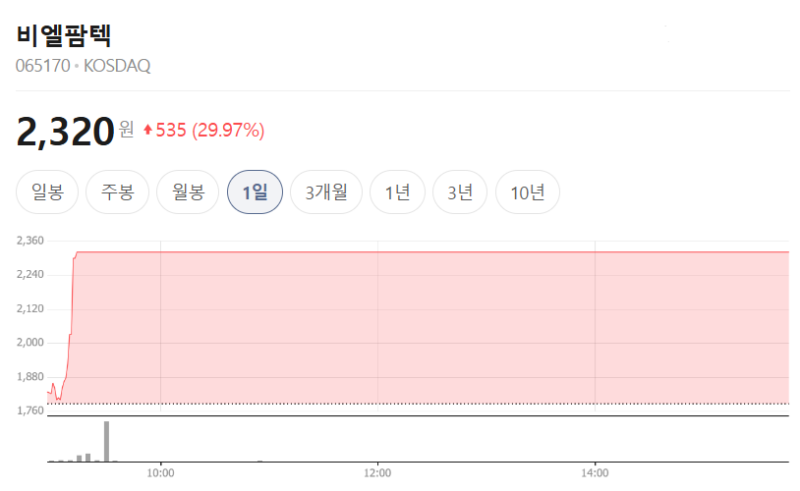
BL PharmTech stock trend on Jun 19.(Image=Naver Finance)
◇BL PharmTech Discusses Global Licensing Opportunities for Molecular Glue-Based Cancer Drug
BL PharmTech's shares surged 29.97% on the day to close at 2,320 won, driven by growing expectations for the company's next-generation oncology pipeline. The company announced that it will participate in BIO USA 2026, the world's largest biotechnology partnering event, scheduled to take place from June 22 to 25 at the San Diego Convention Center in the United States. At the event, BL PharmTech plans to showcase its next-generation anticancer drug platform and global business expansion strategy.
During BIO USA 2026, BL PharmTech will hold partnering meetings with global companies specializing in antibodies, antibody-drug conjugates (ADCs), and targeted protein degradation (TPD). Discussions will focus on the company's lead candidate, ML301, including potential global licensing agreements, collaborative research opportunities, and applications involving emerging therapeutic modalities.
ML301 is a molecular glue-based anticancer drug candidate being developed to treat difficult-to-treat solid tumors that rely on the Alternative Lengthening of Telomeres (ALT) mechanism. ALT-positive tumors are widely regarded as an area of significant unmet medical need because they are difficult to target with existing treatment approaches. BL PharmTech aims to selectively degrade key proteins essential for cancer cell survival using ML301, thereby delivering a differentiated anticancer mechanism compared with conventional small-molecule inhibitors and proteolysis-targeting chimera (PROTAC)-based therapies.
According to the company, ML301 has demonstrated anticancer activity and tumor growth suppression potential in cell-based studies using ALT-positive cancer cells as well as in animal models. Molecular glue technology is considered competitive due to its relatively low molecular weight and catalytic mechanism of action compared with conventional drug discovery approaches. These characteristics are expected to support the development of orally administered therapies, provide sustained target protein degradation, and reduce the likelihood of treatment resistance.
At BIO USA 2026, BL PharmTech intends to highlight not only ML301's therapeutic potential but also the scalability of its platform technology.
Among the company's key expansion strategies is ML303, a next-generation ADC and degrader-antibody conjugate (DAC) development platform that utilizes ML301's degrader payload characteristics. Another initiative, ML304, combines the company's technology with blood-brain barrier (BBB) shuttle antibody platforms to expand into central nervous system (CNS) disorders. ML303 is being evaluated as a next-generation smart payload technology designed to address the resistance and toxicity issues associated with conventional ADC therapies.
"BL PharmTech has already scheduled meetings with numerous global companies at BIO USA," said Park Young cheol, Chairman of BL PharmTech. "Starting with biomarker-defined indications such as ALT-positive cancers, we will actively explore collaborative research opportunities that combine our technology with ADCs, DACs, BBB shuttle antibodies, and various other innovative platforms."
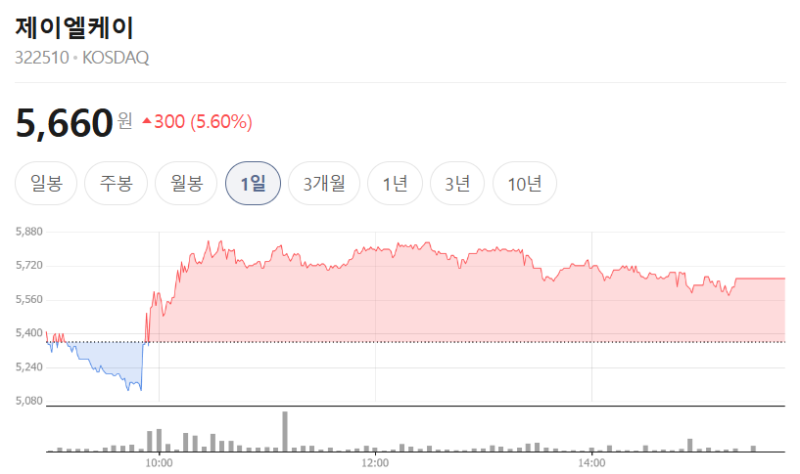
JLK stock trend on Jun 19.(Image=Naver Finance)
◇JLK Builds Alzheimer's Medical Imaging AI Platform, Expands Dementia Business
JLK's shares rose 5.60% from the previous trading session to close at 5,660 won. The company announced plans to expand its dementia-related business through the development of TRACEGENT, an artificial intelligence (AI)-powered medical imaging platform for Alzheimer's disease.
Alzheimer's disease is the most common form of dementia, accounting for approximately 60% to 70% of dementia cases worldwide. With the recent launch of a series of treatments targeting amyloid-beta, a key pathological hallmark of Alzheimer's disease, the importance of medical imaging has increased significantly in both patient selection and treatment monitoring.
In particular, demand for imaging analysis technologies that support clinicians has grown as the need for magnetic resonance imaging (MRI)-based monitoring before and after treatment continues to rise. To address these market trends, JLK has developed TRACEGENT, an Alzheimer's medical imaging AI platform that integrates MRI- and positron emission tomography (PET)-based analysis technologies.
TRACEGENT has been developed by leveraging JLK's expertise in medical image analysis accumulated through its stroke AI business. The platform is designed to comprehensively utilize Alzheimer's-related imaging data by linking MRI-based and PET-based analysis technologies, enabling efficient management and analysis of various medical imaging datasets.
JLK plans to commercialize TRACEGENT following the completion of regulatory approval procedures in both domestic and international markets.
Building on its Alzheimer's disease initiatives, the company also intends to expand its research and development efforts into other neurodegenerative disorders, including vascular dementia, dementia with Lewy bodies, and Parkinson's disease dementia. Through these efforts, JLK aims to strengthen its competitiveness in the AI-powered dementia healthcare market.
"As the market for Alzheimer's therapies continues to expand, the importance of utilizing medical imaging data is becoming increasingly significant," a JLK official said. "Leveraging our medical imaging AI technologies, we plan to further enhance our research and development capabilities in the dementia field while continuously advancing our related platform technologies."
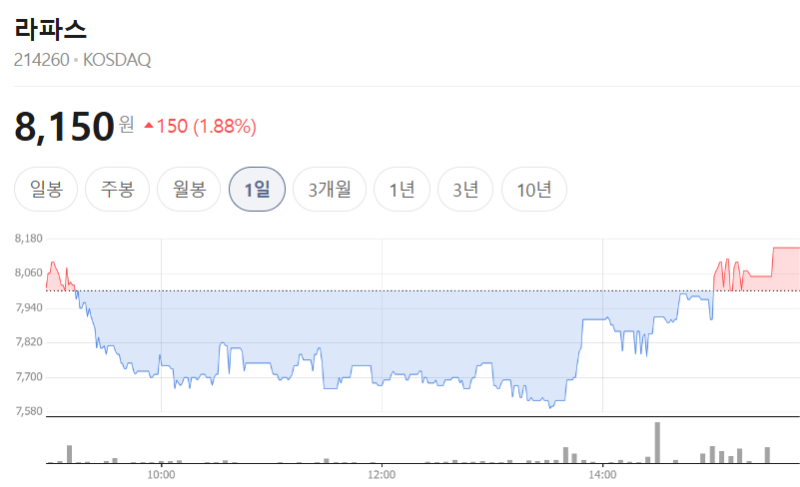
Raphas stock trend on Jun 19.(Image=Naver Finance)
◇Raphas Advances AI-Based Autonomous Manufacturing of Microneedles
Raphas' shares rose 1.88% from the previous trading session to close at 8,150 won, extending their gains for a second consecutive day. Investor sentiment was supported by the company's plan to implement an artificial intelligence (AI)-driven autonomous manufacturing system for microneedles.
Raphas recently signed an agreement after being selected as a beneficiary of the Autonomous Factory Development Project under South Korea's Smart Manufacturing Innovation Support Program, led by the Ministry of SMEs and Startups.
An autonomous factory is an advanced smart manufacturing system that utilizes digital technologies such as AI, data analytics, and digital twins to automate production processes and improve operational efficiency. The project has a total budget of approximately 1.2 billion won. Under the initiative, Raphas plans to establish an AI- and digital twin-based autonomous manufacturing system for microneedles at its Cheonan production facility.
Key objectives of the project include logistics automation through automated equipment and autonomous mobile robots (AMRs), the development of AI-based quality prediction and equipment optimization systems, and the implementation of a digital twin platform capable of real-time production monitoring and remote control.
Microneedles are a platform technology consisting of microscopic needles designed to deliver drugs through the skin. Maintaining consistent product quality and standardized manufacturing processes is critical in microneedle production. Through this project, Raphas aims to establish a data-driven process management framework and enhance manufacturing efficiency.
The company also plans to minimize human intervention by increasing automation levels while strengthening quality control capabilities. Leveraging these advancements, Raphas intends to further expand its production capabilities in prescription pharmaceuticals and vaccine manufacturing.
"This autonomous factory project is more than a cost-reduction initiative," a Raphas official said. "It represents a strategic investment aimed at proactively meeting the stringent aseptic manufacturing standards required by global pharmaceutical companies through the adoption of logistics robots and AI technologies. Based on the manufacturing competitiveness we secure through this project, we intend to generate tangible results in our vaccine and contract development and manufacturing organization (CDMO) business."