“A Fractured, Frenzied and Fearful World... Yet ‘Prosperity’ Will Prevail” [ESF2026]
[Sub-Title]
Day 2 of the 17th Edaily Strategy Forum
Keynote Speech by Honorary Professor Norina Hertz, UCL Institute for Global Prosperity
“Leaders Should Possess a Broad Perspective, Solidarity, and Cohesion”
[Edaily By Reporter Yu-rim Lee and Yeon-seo Kim] “If we were to define the world today, it would be a world that is fractured, frenzied, and fearful.”
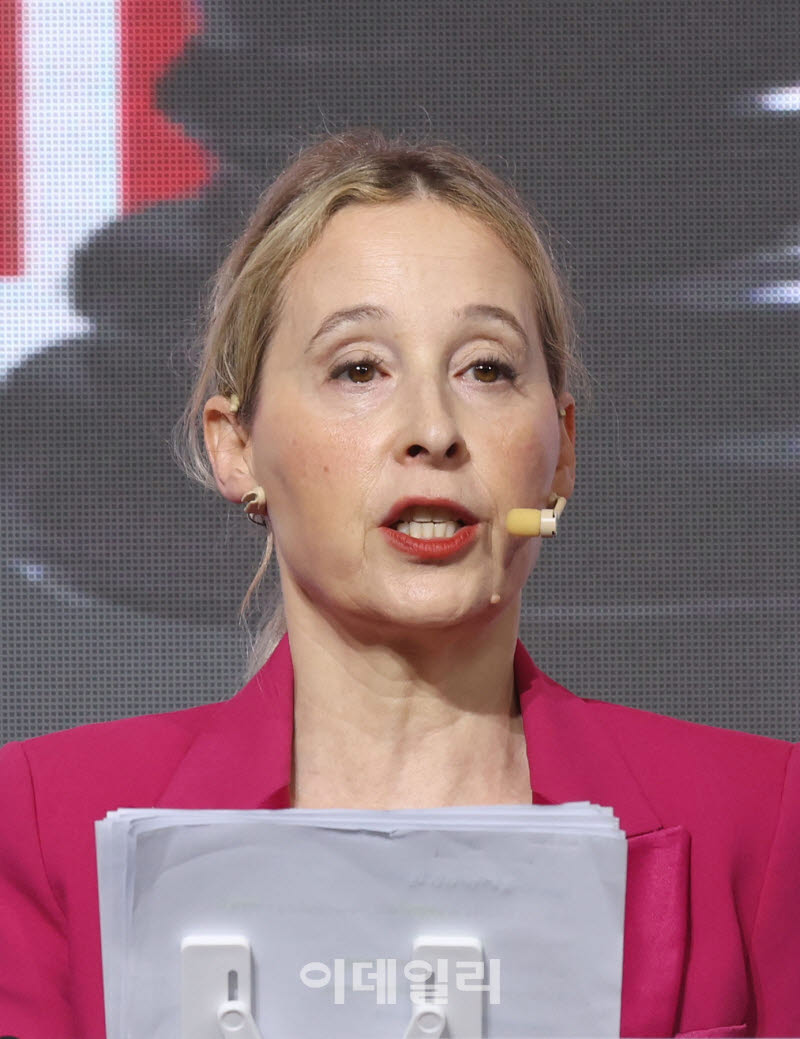
Honorary Professor Norina Hertz of University College London’s (UCL) Institute for Global Prosperity delivered a keynote speech on the theme “How to Thrive in an Age of Division and Uncertainty” at the 17th Edaily Strategy Forum held on June 17 at The Shilla Seoul in Jung-gu, Seoul. (Photo = Young-hoon Lee, Edaily Reporter)
Professor Hertz proclaimed that the globalized order centered around ‘free trade and free markets,’ which we once took for granted, has ‘effectively come to an end.’ She explained that protectionism and trade barriers are becoming widespread.
Regarding this state of “fracture,” she said it would “extend beyond conflict between nations and also lead to division within countries, driven by gaps between generations, genders, and wealth.” She also said of Korea that “55% of Gen Z reportedly supports a strong leader or authoritarian rule,” adding that “a very important task for Korea will be figuring out how to harmonize relationships among internal members.”
Concerning the “frenzied” adoption of Artificial Intelligence (AI) technology, Professor Hertz cautioned, “The more dependent we become on AI, the more our critical thinking and decision-making capabilities may inevitably weaken,” and advised that “To secure strategic autonomy, Korea should should discuss where it should position itself within the AI value chain in order to secure strategic autonomy.”
She further said that people experience deep “fear” over the social changes brought by AI, analyzing that “When individuals feel anxious or stressed, their concentration, judgment, and productivity can severely decline, which subsequently impacts consumer spending behavior as well.”
Nevertheless, Professor Hertz said she expects “prosperity” to emerge, noting that patent applications and clinical trials are currently hitting historical highs, while innovation in culture, the arts, and robotics is accelerating rather than slowing.
In closing, Professor Hertz highlighted the attitudes leaders should have in times of crisis if they want to seize opportunities and design the new world. “Leaders must cultivate a broad perspective, surround themselves with people who challenge their thinking, foster solidarity and cohesion, and make time for reflection,” she said. “Only then will they be able to identify the opportunities that others overlook amid the noise and confusion surrounding them.”