“Korea‘s Core Strength Lies in Shipbuilding and AI Infrastructures; Public-Private Cooperation Must Be Further Strengthened in Foreign Strategy” [ESF2026]
[Sub-Title]
Day 2 of the 17th Edaily Strategy Forum
Keynote speech by Rexon Ryu, President of The Asia Group
Industrial and Partnership Capabilities Become Critical Beyond Traditional Security
Establish Irreplaceable Position in Core Supply Chains to Shape Global Rules
U.S.-Korea Alliance Should Be Redefined as a Partnership-Driven Relationship
[Edaily By Reporter Eung-tae Kim, Ha-yeon Shin, Min-ji Son, and Trainee Reporter Tae-seob Kim] “The true meaning of self-reliance is building a country that can continue to prosper regardless of the policy choices made by the U.S. Korea should become a designer that actively shapes the new world, rather than simply following the order set by other countries.”
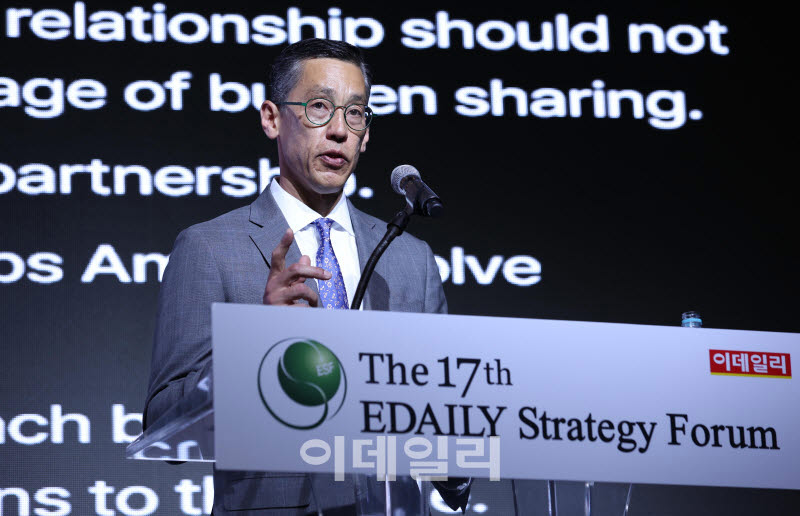
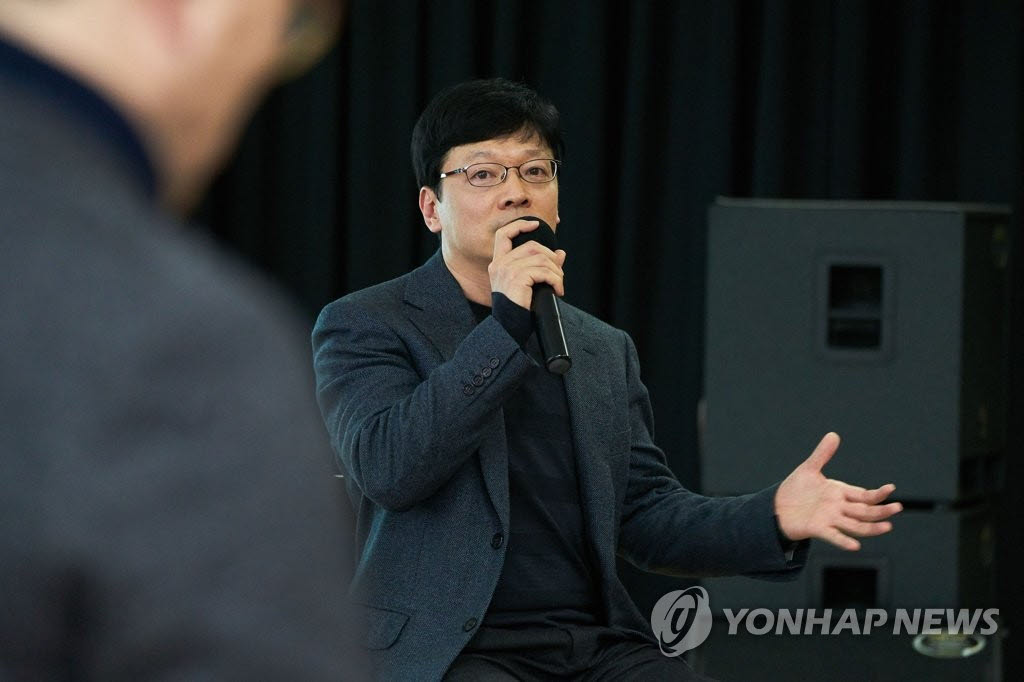
The 17th Edaily Strategy Forum was held on June 17 at the Shilla Hotel in Jung-gu, Seoul, under the theme “The Age of Power, Recasting Civilization : Who Designs the New World?” Rexon Ryu, President of The Asia Group (TAG), is delivering a keynote speech on the topic “Security and Defense Strategy in the Era of Self-Reliance.” (Photo = Jin-hwan Noh, Edaily Reporter)
Ryu suggested that Korea should begin by adopting an expanded perspective beyond traditional concepts of security in order to avoid being manipulated by the international order. “Traditionally, security has been understood as the ability to defend territory and borders, citizens, soldiers, ships, and missile alliances, but that is no longer sufficient,” he said. “In the future, security will mean whether a nation can innovate, manufacture, protect, and expand, and whether it has partnerships to rely on when a crisis comes.”
From this analytical perspective, he pointed out that Korea should aggressively leverage its advanced industrial infrastructures, particularly in sectors like Artificial Intelligence (AI). “AI lies at the center of all global changes and will influence everything from semiconductors and power grids to daily life and future norms,” he noted. “All the AI models the world is paying attention to run on semiconductor memory, and Korea holds a central position in that layer.”
He also highlighted Korea’s competitiveness in shipbuilding and defense manufacturing. “China accounts for roughly 50% of global shipbuilding capacity, while Korea accounts for around 30%,” Ryu noted. “The U.S. accounts for less than 1%, illustrating the strategic weakness of its industrial base in this sector.” “Korea‘s defense industry has likewise entered a new phase,” he added. “Poland now regards Korea as its second most important ally after the U.S., reflecting the growing international recognition of Korea’s defense capabilities.”
President Ryu strongly emphasized that Korea should establish multi-layered global partnerships based on its industrial infrastructure, making itself an irreplaceable player within core supply chains to effectively design its national security and defense strategies. “Korea should move beyond the conventional role of a ‘Fast Follower,’” Ryu stated. “and actively participate in establishing international norms and writing the rules of the new security and economic era as a trusted strategic partner.”
He particularly focused on the need to redefine the Korea-U.S. alliance around a true partnership. “Korea is no longer a customer buying services from the U.S.,” Ryu said. “It is becoming an investor with a stake, and a stake comes with the right to participate in decision-making.” He added, “The next chapter of the Korea-U.S. relationship should be defined not by burden-sharing, but by partnership,” and said that “the alliance should become a platform for shared leadership in the core areas that will determine future hegemony.”
Ryu also stressed stronger strategic alignment between the government and the domestic industry in global security strategy. He argued that if views are not aligned at domestically, security and defense strategy could lose strength in the global market. “Korea‘s leading corporations act as the primary engines driving national competitiveness, and their corporate decisions directly impact overall national strategy,” he said. “As elements like export controls, investment screening, and product competitiveness have become just as vital as conventional defense, public-private cooperation must become even closer.”
“Ultimately, the essential question is who will design the new world,” he said. “Korea must not become merely an object shaped by others.” adding that “Korea should combine its substantial capabilities with a clear vision to make its geopolitical strategy more concrete, and build the power to stand on its own.”