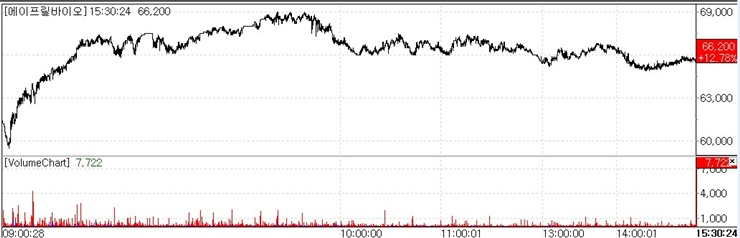
AprilBio stock trend.(Source=KG Zeroin MP DOCTOR)
◇AprilBio’s Licensed Out Atopic Dermatitis Drug May Expand Into Additional Indications
According to KG Zeroin MP DOCTOR on May 8, shares of AprilBio rose 12.78%(7,500 won) to close at 66,200 won.
The rally came as investors focused on the expanding indication potential of APB-R3(EVO301), a pipeline asset licensed out by AprilBio. Its U.S. partner Evommune recently unveiled updated clinical development and multi indication expansion plans for EVO301 in its first-quarter corporate update.
EVO301 is a long-acting fusion protein combining interleukin-18(IL-18) binding protein with an anti-serum albumin Fab associated domain. The company says the molecule may improve distribution into inflamed tissues compared to conventional monoclonal antibodies(mAbs).
Notably Evommune announced completion of a high concentration subcutaneous(SC) formulation and entry into the manufacturing stage. Based on this the company plans to initiate a Phase 2b trial in atopic dermatitis(AD) patients in mid-2027. The study will employ a placebo controlled dose ranging design with at least three dosing regimens over a 16week treatment period.
The market is particularly paying attention to the company’s indication expansion strategy. In addition to atopic dermatitis and ulcerative colitis(UC) Evommune disclosed it is evaluating further Phase 2 development opportunities in cardiovascular inflammatory diseases and food allergies, effectively signaling a third indication expansion strategy for EVO301.
An AprilBio official said “Mentioning indication expansion before releasing final clinical data implies confidence in the underlying results.”
adding “Companies generally do not discuss broader indications unless the data are encouraging.”
The official added “Expanding beyond ulcerative colitis into cardiovascular disease and food allergies suggests the IL-18 target itself is functioning effectively.” noting that broader indications could also increase milestone payment opportunities.
The transition to an SC formulation was also viewed positively. The company explained “Even highly effective therapies can face commercial limitations if they rely on intravenous(IV) administration. The move toward SC development raises expectations for improved convenience and competitiveness.”
Investors also appeared encouraged by expectations for improved efficacy in future trials. “The earlier study showed EASI score improvements comparable to competing drugs despite only two doses over a 12week observation period.”
the company said “With a 16-week observation period and increased dosing planned for the next trial, there is potential for even stronger outcomes.”
Evommune is also scheduled to present preclinical data at SID 2026, the Society for Investigative Dermatology meeting taking place in Chicago from May 13 to 16. The company plans to highlight IL-18 inhibition mechanisms in atopic dermatitis and differentiation of its binding protein approach.
◇Hugel Soars on Q1 Earnings Surprise Driven by Toxin, Filler Growth
Hugel also surged after posting record first-quarter earnings. Shares rose 12.33%(32,000 won) to close at 291,500 won.
The company reported first quarter consolidated revenue of 116.6 billion won, operating profit of 47.6 billion won and net profit of 40.6 billion won up 29.9%, 22.3% and 31.5% year over year respectively. The results significantly exceeded market expectations.
Growth was broad based across botulinum toxin, fillers and skin boosters and cosmetics businesses. Botulinum toxin revenue rose 60.6% year-over-year to 65.4 billion won in the first quarter. Sales in North and South America surged more than 420% thanks to increased shipments to the U.S. and Brazil, while Europe and Asia-Pacific(APAC) regions also recorded steady growth.
A Hugel official said “First quarter performance was largely driven by expanded toxin shipments to Brazil and the United States. Since the U.S. launch in March last year and re entry into Brazil in September sales growth has accelerated meaningfully.”
Domestic toxin sales also rose 5% year over year despite concerns about market saturation and intensifying competition. The company noted that sales have continued recovering since bottoming out in the third quarter of last year.
Revenue from fillers and skin boosters reached 32.1 billion won supported by roughly 10% growth in Europe and other regions aided by aggressive marketing efforts.
Cosmetics and other businesses generated 19.2 billion won in revenue, up 30.6% year-over-year. The segment now accounts for roughly 16% of total sales and is increasingly viewed as a future growth engine. Hugel is also preparing for further domestic expansion in the second half through the acquisition of distribution rights for ECM based products.
Park Jong hyun said “Improved gross profit margins driven by strong toxin sales allowed Hugel to exceed market expectations.”
adding “2026 is expected to mark the beginning of overseas cosmetics expansion and broader portfolio diversification.”
◇CorestemChemon Jumps on Imminent ALS Drug Approval Expectations
CorestemChemon also posted sharp gains, with shares climbing 20.92%(775 won) to close at 4,480 won. The surge was attributed to growing expectations surrounding final approval for its ALS treatment Neuronata-R.
Neuronata-R is an ALS therapy utilizing autologous bone marrow-derived mesenchymal stem cells. The treatment first received conditional approval in Korea in 2014 and has since been marketed domestically. CorestemChemon has applied for full approval based on post marketing surveillance(PMS) data and topline Phase 3 clinical results obtained last year.
Investors focused particularly on the Central Pharmaceutical Affairs Council(CPAC) meeting held on April 17 under the Advanced Biopharmaceutical Subcommittee of Korea’s National Institute of Food and Drug Safety Evaluation. CPAC is considered the final expert review stage before regulatory approval decisions by the Ministry of Food and Drug Safety(MFDS).
Industry sources note that final approval decisions are typically issued within three to four weeks after a CPAC review, suggesting a regulatory conclusion for Neuronata-R may be imminent.
Although the Phase 3 trial failed to meet its primary endpoint, CorestemChemon achieved statistical significance in biomarker analyses. Additional subgroup analyses involving patients with slower disease progression reportedly demonstrated statistical significance in both neurofilament light chain(NfL) biomarkers and the Combined Assessment of Function and Survival(CAFS) endpoint.
The market is paying close attention to the possibility of conditional approval extension or label modification considering the rarity of ALS and precedents involving advanced biopharmaceutical approvals in Korea.
CorestemChemon is also preparing for global expansion. In 2023, the company relocated its manufacturing facility from Yongin to Osong Bio Science Complex in North Chungcheong Province and is currently undergoing GMP certification procedures for the new site.
Although Neuronata-R had been commercially available in Korea for nearly a decade following its conditional approval, actual sales had been limited in recent years due to manufacturing relocation and GMP certification issues.
The company is currently conducting equivalence testing between products manufactured at the Yongin and Osong plants and expects domestic production and sales normalization in the second half of this year.