(사진=엘앤씨바이오)
ECM refers to the extracellular matrix, a network of collagen, elastin and other components that surrounds and supports cells and helps provide tissues with their structural and physical environment.
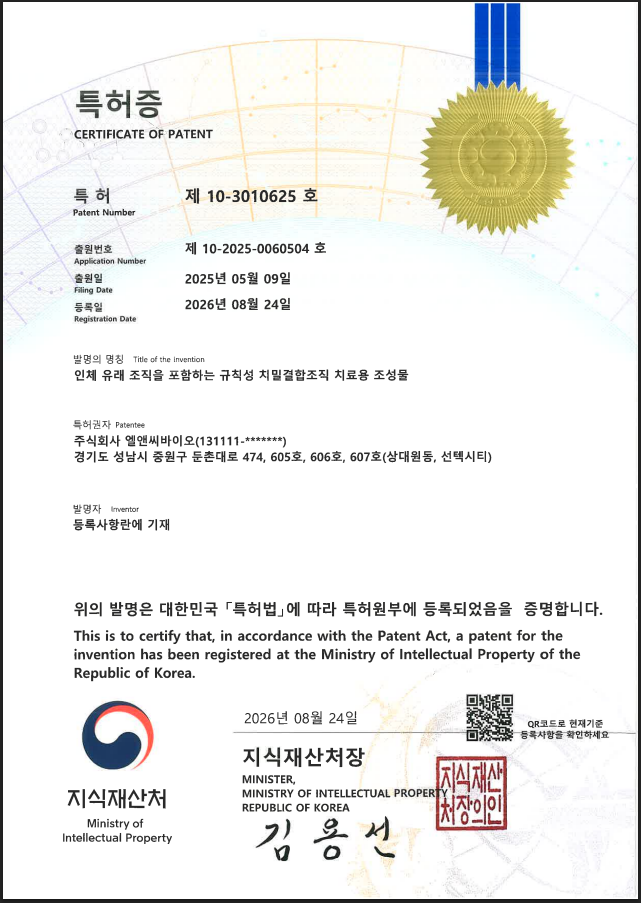
L&C Bio developed a process that decellularizes and delipidates human tendon tissue, processes it into fine tendon ECM particles and formulates the material into an injectable product. The company has now secured a Korean patent covering the technology.
A key feature of the patent is that the technology does not rely solely on individual proteins such as collagen. Instead, it preserves and utilizes the inherent structural characteristics of ECM found in human tendon tissue and translates them into an injectable formulation suitable for clinical use.
L&C Bio has also established key formulation parameters required for product development, including particle size, viscosity and injection force, providing a foundation for advancing the technology from a research-stage material into a commercial product.
Tendons have highly organized ECM structures in which collagen and other components are aligned in specific directions. Aging, trauma and repetitive stress can weaken or damage this matrix. Rather than using a general-purpose biomaterial, L&C Bio is focusing on ECM derived directly from human tendon tissue to physically supplement damaged or depleted ECM and provide a tissue-specific structural microenvironment.
L&C Bio researchers have previously published findings on the tissue reconstruction potential of human tendon-derived ECM in an international scientific journal. With the latest patent, the company has secured intellectual property covering core technologies needed for commercialization, from tendon tissue processing and micronization to injectable formulation.
Based on the technology, L&C Bio is developing an injectable tendon ECM product for use in tendon and ligament areas. The company is evaluating its potential as a material that could physically supplement ECM in areas such as the Achilles tendon and shoulder tendons, where the matrix may be weakened or damaged because of aging, repetitive use or injury.
L&C Bio plans to move toward commercialization through manufacturing process standardization, quality evaluation, biological safety testing and efficacy assessment.
The patent also marks an expansion of L&C Bio’s tissue-specific ECM platform into the tendon field. The company has developed and commercialized a range of human tissue-based products, including the skin ECM product Re2O, the bone ECM product Mega DBM, the cartilage ECM product MegaCarti and the nerve ECM product MegaNerve.
By adding tendon ECM technology, L&C Bio is broadening its musculoskeletal portfolio beyond bone and cartilage to include tendons and ligaments.
The tissue-specific ECM platform is based on developing materials and products tailored to the unique structure and characteristics of ECM in individual tissues, including skin, bone, cartilage, nerves and tendons, rather than applying a single general-purpose ECM material across multiple tissue types.
L&C Bio said it plans to continue expanding its ECM technology and product portfolio across a wider range of human tissues.
“This patent is significant because it secures core technology that enables us to formulate a material utilizing the unique ECM characteristics of human tendon tissue into an injectable product,” said Ki-won Lee, head of research and development at L&C Bio. “Following bone and cartilage, we plan to broaden our musculoskeletal ECM portfolio into tendons and ligaments while continuing to expand our tissue-specific ECM platform across areas including skin and nerves, strengthening our technological competitiveness in human tissue-based reconstructive medicine.”