Samsung Biologics shares plunged 6.78% following the company’s announcement of a large-scale 3 trillion won rights offering. VUNO shares also fell sharply in after-hours trading after the company announced plans for a 31.4 billion won rights offering following the close of the regular session.
Shares of SHINPOONG PHARMACEUTICAL surged amid signs of a resurgence in COVID-19 infections, as investors renewed interest in the company, which was previously associated with COVID-19 stocks. CHO-A PHARM shares also jumped, largely attributed to the impact of a recent reverse stock split.
◇Rights offering raises dilution concerns
Samsung Biologics shares closed at 1.486 million won ($1,060), down 108,000 won, or 6.78%, from the previous session, according to KG Zeroin's MP DOCTOR. The shares fell as much as 7.15% to 1.48 million won during the session.
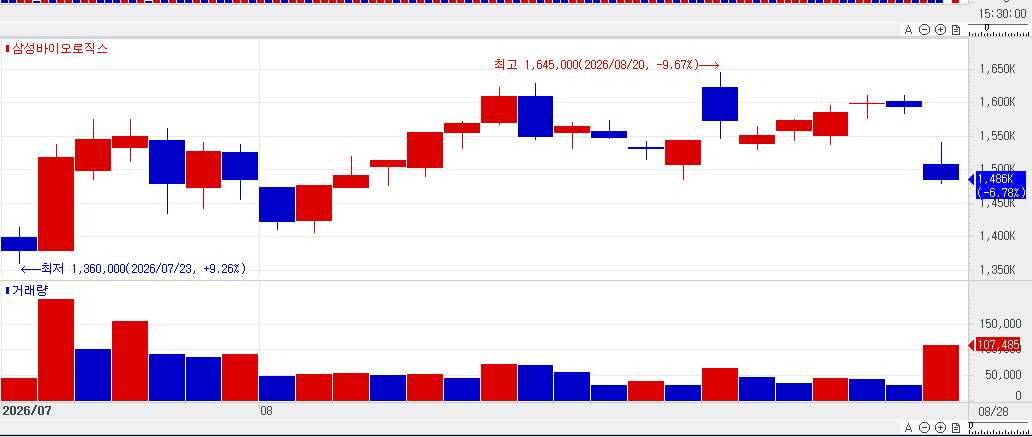
Recent share price trend of Samsung Biologics.(Source : KG Zeroin MP DOCTOR)
The stock plunged immediately after the market opened at 9 a.m. It recovered gradually to around 1.538 million won by 10 a.m. before resuming its decline and ending the session near the day's low.
The decline came after Samsung Biologics announced plans to issue 2.27 million new common shares at 1.322 million won each, raising about 3 trillion won ($2.2 billion). The new shares represent about 4.904% of the company's existing shares.
Samsung Biologics said the proceeds will be used to finance its acquisition of PolyPeptide Group and the expansion of its second bio campus in Songdo, Incheon. The company described the move as part of a strategy to expand across three areas: production capacity, its portfolio and geographic presence.
About 2.7062 trillion won of the proceeds will go toward the acquisition of PolyPeptide Group, while 294.8 billion won will be allocated to expanding the second bio campus.
Samsung Biologics announced July 20 that it would acquire global peptide CDMO company PolyPeptide Group for about 2.7 trillion won. The deal is the largest merger and acquisition involving a South Korean pharmaceutical or biotechnology company and marks Samsung Biologics' entry into peptide manufacturing.
Peptides are short chains of amino acids, generally consisting of two to 50 amino acids. They act as hormones or signaling molecules in the body and can be synthesized as medicines to treat diseases.
GLP-1, or glucagon-like peptide-1, drugs used to treat obesity and diabetes are among the best-known examples of peptide medicines. They mimic a naturally occurring hormone that stimulates insulin secretion and promotes feelings of fullness.
The sharp decline in Samsung Biologics shares is being attributed to concerns that the rights offering will dilute existing shareholders' ownership.
Investors are also watching whether Samsung Biologics' major shareholders, Samsung C&T and Samsung Electronics, will participate in the offering. Samsung Electronics and Samsung C&T hold 31.22% and 43.06% stakes, respectively, giving them a combined 74.28% ownership. If the two companies subscribe for all of their allocated new shares, the burden on minority shareholders could be reduced.
◇VUNO Shares Plunge After 31.4 Billion Won Rights Offering
VUNO, an artificial intelligence medical technology company, also saw its shares plunge in after-hours trading after announcing plans for a 31.4 billion won rights offering at around 4:20 p.m. Friday.
At around 6 p.m., VUNO shares were trading at 6,000 won apiece, down 18.70% from the previous session.
The rights offering is aimed at reducing the company’s interest burden, according to VUNO.
Lee Ye-ha, VUNO’s CEO, said the company decided to act ahead of an interest rate adjustment on its third perpetual convertible bond, which is scheduled for December 2026. The interest rate will increase in stages following the adjustment date, he said.
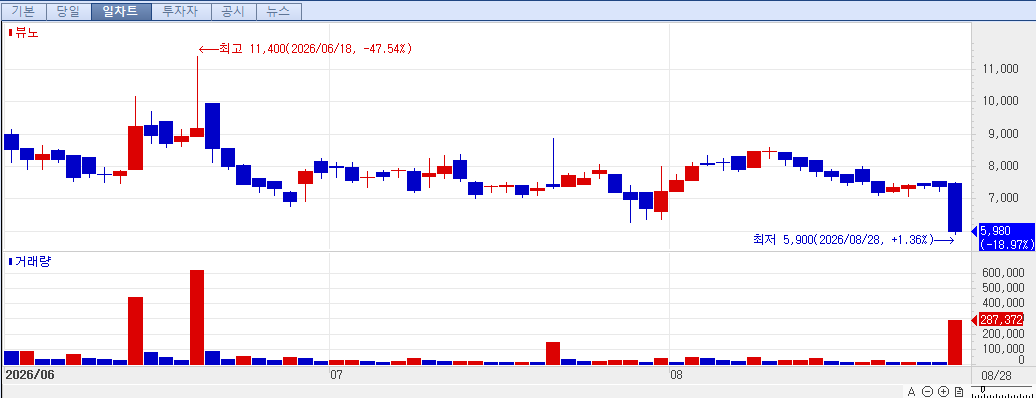
Recent share price trend of Vuno.(Source : KG Zeroin MP DOCTOR)
“Given this, we determined that it would be optimal to respond proactively before that point,” Lee said. “We concluded that a public rights offering was the most reasonable option, as it would allow us to strengthen our financial structure by directly raising capital without incurring potential interest or repayment burdens.”
Before asking shareholders to participate in the offering, VUNO redesigned its overall work processes through the use of AI transformation, Lee said.
He added that VUNO fully repaid about 9.3 billion won in principal and interest on its second perpetual convertible bond on Aug. 26, ahead of maturity.
“The funds raised through this public rights offering will be used primarily to repay the third perpetual convertible bond early, eliminating interest costs and potential dilution,” Lee said. “The remaining proceeds will be used as working capital for business expansion, including research and development, sales and marketing, and operations at overseas subsidiaries.”
VUNO was established in December 2014 and drew attention after receiving South Korea’s first approval for an AI-based diagnostic-assistance medical device in 2018.
◇COVID-19 concerns lift SHINPOONG PHARMACEUTICAL
SHINPOONG PHARMACEUTICAL shares jumped 15.05% to 10,170 won. The stock rose as much as 23.64% to 10,930 won early in the session before giving up some of its gains.
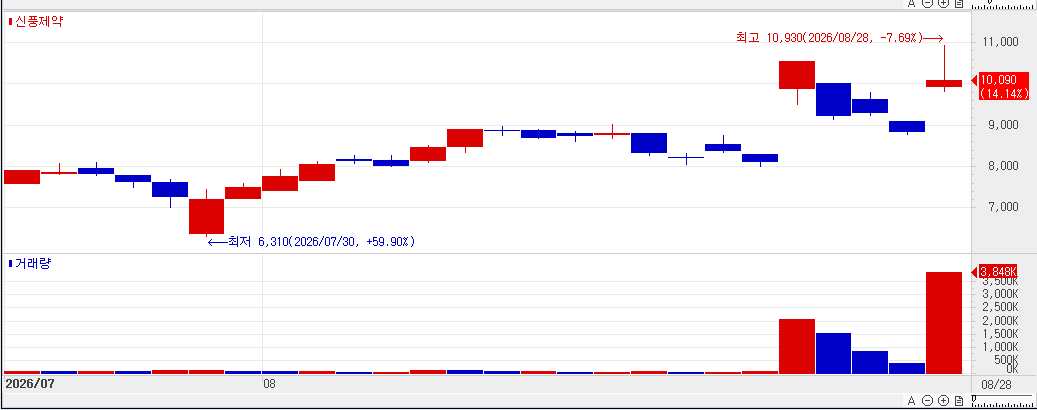
Recent share price trend of SHINPOONG PHARMACEUTICAL.(Source : KG Zeroin MP DOCTOR)
The rally came amid growing concerns about a resurgence of COVID-19 infections.
The China Center for Disease Control and Prevention said last month that the number of COVID-19 infections had reached 522,000, up sharply from 79,000 in June.
SHINPOONG PHARMACEUTICAL was previously considered a COVID-19-related stock after developing Pyramax, an antimalarial drug, as a potential treatment for COVID-19.
The company ultimately failed to establish Pyramax as a COVID-19 treatment, meaning a renewed outbreak is unlikely to translate directly into improved earnings for SHINPOONG PHARMACEUTICAL.
Still, the company's shares have repeatedly shown sharp movements when signs of a COVID-19 resurgence emerge.
◇CHO-A PHARM rallies after 5-to-1 reverse split
CHO-A PHARM shares rose 20.97% to 3,230 won, extending their gains after trading resumed following a 5-to-1 reverse stock split.
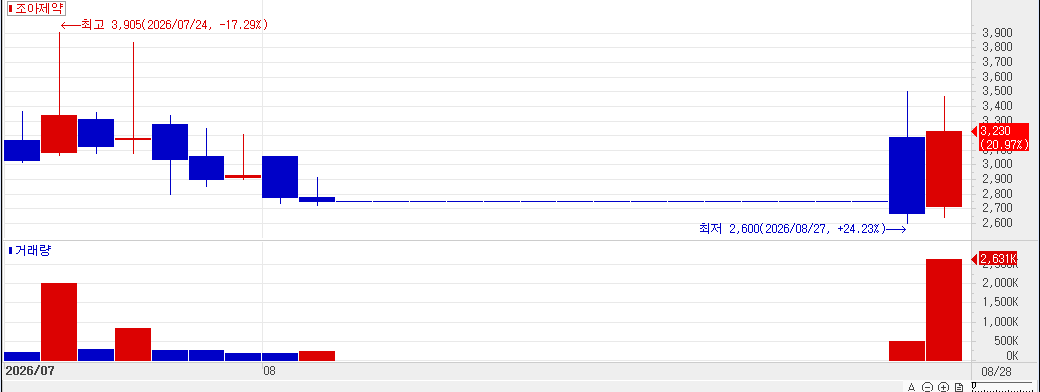
Recent share price trend of CHO-A PHARM.(Source : KG Zeroin MP DOCTOR)
The company approved the reverse split July 22, after which trading was suspended from Aug. 5 through Aug. 26. Trading resumed Aug. 27.
Under the reverse split, the company's par value per share increased from 500 won to 2,500 won, while the number of shares outstanding fell from 30.98 million to about 6.20 million.
A reverse stock split combines multiple existing shares into a smaller number of shares, generally raising the nominal share price. The move is often used by companies whose share prices have fallen to very low levels.
The split comes as South Korea implements tougher delisting rules for so-called penny stocks. Under the new rules, a company can be designated as a management concern if its share price remains below 1,000 won for 30 consecutive trading days. If it fails to recover to at least 1,000 won for 45 consecutive trading days during a subsequent 90-trading-day period, delisting procedures can begin.
Companies must also meet minimum market capitalization requirements. The threshold is 20 billion won this year and will rise to 30 billion won next year. CHO-A PHARM's market capitalization stood at about 20 billion won Friday.
CHO-A PHARM reported first-half revenue of 29.9 billion won, up 6.6% from a year earlier. Its operating loss narrowed to 1.1 billion won from 3.6 billion won a year earlier.